
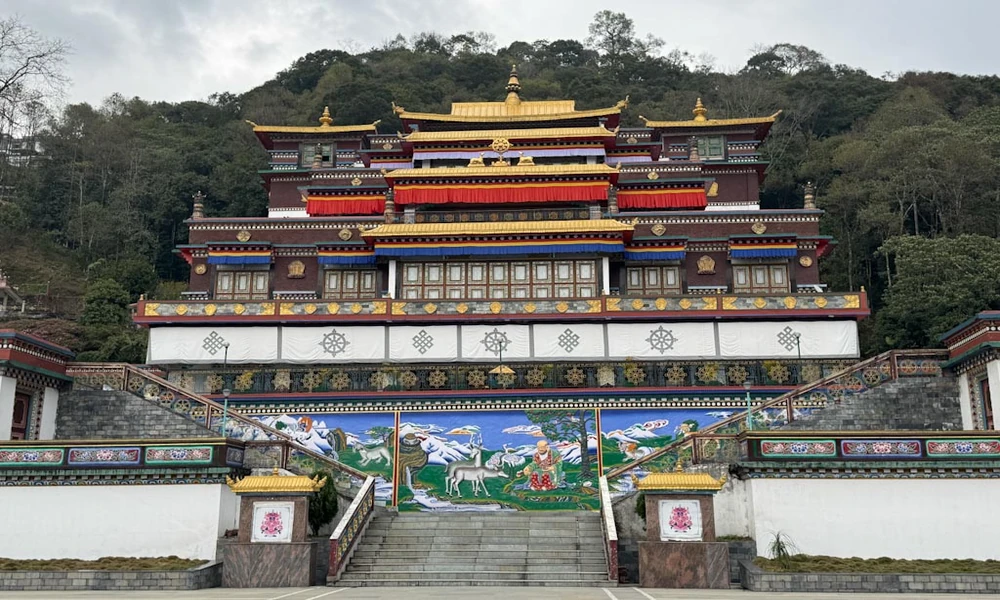
The first time I walked into a monastery in Sikkim, I got the small things wrong. I stepped on the wooden threshold instead of over it, turned the wrong way around the prayer hall, and lifted my phone before anyone told me not to. An old monk at Rumtek watched me do all three, smiled, and pointed clockwise with two fingers. That one gesture taught me more than the guidebook in my bag.
Sikkim has more than 200 monasteries, and the good part for a traveler is that the best of them line up along a route you can drive in about a week. This is a guide to the monasteries in Sikkim built as an actual trail, not a list of names you tick off from a car window. I want you to know what you are looking at, what happens when the horns start at dawn, and how to stand in a prayer hall without a monk having to correct you.
I have done this loop four times across different seasons. Here is what I would repeat, and what I would do differently.
How to read a Sikkim monastery before you step inside
Most gompas here follow the same logic once you learn to see it. On the roof, look for two gilded deer facing a wheel. That is the Dharma Chakra, a reminder of the Buddha’s first teaching. Strings of prayer flags run off the eaves in five colors, blue for sky, white for air, red for fire, green for water, yellow for earth, and the wind is meant to carry the printed prayers outward as they fade.
Inside, your eyes take a minute to adjust. The smell hits first, juniper smoke and the warm, slightly sour note of butter lamps. The walls are painted floor to ceiling with murals and hung with thangkas, cloth paintings of deities and mandalas that work as teaching aids rather than decoration. There is almost always a large seated Buddha or a statue of Guru Rinpoche, the teacher credited with bringing Buddhism across the Himalayas.
Two habits matter from the doorway. You walk clockwise, keeping the shrine and the monks on your right. And you spin the prayer wheels, the metal drums along the walls, clockwise too, each turn releasing the mantra rolled up inside. Once you understand the layout, every monastery on this trail starts to feel like a variation on a theme you already know.
Building your monastery trail: East first, then West
The route that works best runs from the busier east to the older, quieter west. Fly into Bagdogra near Siliguri, or into Pakyong if you can find one of its limited flights, or take a train to New Jalpaiguri (NJP). From any of those, it is roughly a four to five hour drive up to Gangtok by shared or private cab.
Base yourself in Gangtok for two nights to cover the eastern cluster. Then drive west, dropping down through Ravangla in the south for one monastery worth the detour, and on to Pelling, which puts you within reach of the oldest sites in the state. Pelling to Gangtok is about 120 to 130 km, and mountain roads here run slow, so budget four to five hours for that leg alone. Five to six days gives you the trail without a rushed feeling.
East Sikkim: the monasteries around Gangtok
Rumtek Monastery
Rumtek sits about 23 km from Gangtok, on a hill facing the city across a valley. It is the largest monastery in Sikkim and the seat of the Karma Kagyu school, rebuilt in the 1960s as the main center of that lineage outside Tibet. The main hall holds a gilded stupa connected to the 16th Karmapa, and the murals here are some of the best kept on the whole trail.
Go early. It opens around 6 am and closes near 6 pm, and by mid morning the shared jeeps arrive and the calm thins out. Carry a photo ID, because there is a police check post at the gate and you sign in. Entry was a token amount of about 10 rupees as of my last visit in 2025. The one thing I would skip is the row of souvenir stands on the approach path, where the same singing bowls cost double what you would pay in Gangtok’s main market.
Enchey Monastery
Enchey is inside Gangtok itself, a short ride above the main town, founded in 1909 and belonging to the Nyingma school. It is small and takes maybe half an hour, but the position is lovely in the last hour of daylight, when the light turns amber on the hills. If you can time it, the Chaam masked dances here fall in the winter, usually in January, and the monks in silk robes and painted masks are worth planning a day around.
Do Drul Chorten
Down in Deorali, a little below the main town, this white stupa from 1945 is ringed by 108 prayer wheels. You can walk the full circuit in 20 minutes, turning each wheel as you go, and it is a calm, easy stop to pair with the nearby Namgyal Institute of Tibetology if you want the history behind everything you have been seeing.
West Sikkim: the older, quieter heart of the trail
Pemayangtse Monastery
This is my favorite monastery in Sikkim, and it is only about 10 km from Pelling at around 2,085 m. Founded in 1705, Pemayangtse belongs to the Nyingma school and once ranked among the most important monasteries in the old kingdom. Climb to the top floor and you will find Zangdok Palri, a seven tiered wooden model of Guru Rinpoche’s heavenly palace, carved by a single monk over five years. It is delicate, strange, and unlike anything else on the trail. Entry was about 20 rupees as of early 2025, and it keeps roughly 9 am to 6 pm hours. Pair it with the ruins of Rabdentse, the old royal capital, a 15 minute walk away.
Sanga Choeling Monastery
One of the oldest in the state, dating to about 1697, Sanga Choeling sits on a ridge reached by a 30 to 40 minute uphill walk from Pelling through rhododendron and pine. Fewer people make the climb, which is exactly why I send friends here. Go for the walk and the ridge line as much as the monastery itself.
Tashiding Monastery
Founded in 1641 on a heart shaped hill between the Rathong and Rangeet rivers, Tashiding is the holiest site on this trail for many Sikkimese. It holds 41 chortens and rows of mani stones carved with Om Mani Padme Hum. Its Bumchu festival, on the 14th and 15th days of the first Tibetan month, usually February or March, draws thousands. A sacred pot of water is opened once a year, and the lamas read the level to forecast the year ahead, full for a good year, low for a hard one. It is about 40 km from Gyalshing on rough road, so give it time.
Dubdi Monastery
Above Yuksom, the first capital of Sikkim, Dubdi is often called the oldest monastery in the state, built around 1701. You earn it with a 30 to 40 minute climb through thick forest, and on a still morning you may have the place to yourself apart from a caretaker monk. Yuksom is also where the Goecha La and Dzongri treks begin, so trekkers can fold this one in on their acclimatization day.
A South Sikkim detour worth the extra hour: Ralang
If you route through Ravangla between Gangtok and Pelling, stop at Ralang. The newer Palchen Choeling monastery here is huge, with a gilded roof, and belongs to the Kagyu school, and its Pang Lhabsol and Kagyed mask dances are among the liveliest in Sikkim. Ravangla also has the Buddha Park with its 130 foot statue, a modern site that photographs well against Kanchenjunga on a clear autumn morning.
What actually happens during a prayer ceremony
If you can be at a monastery for the early puja, around 6 am, do it. You will hear the long copper horns first, the dungchen, a sound that seems to come up from the floor. Then cymbals, drums, and the low overlapping chant of monks reading scripture. Butter lamps get lit, offerings of rice and water are set out, and someone may quietly pour you salted butter tea, which is an acquired taste and worth trying once.
You are usually welcome to sit at the back and watch, as long as you are quiet and still. Do not walk between the monks and the altar during the ceremony, and follow whatever a caretaker signals. The evening prayers, closer to sunset, are shorter and often less crowded if the dawn start is too much.
How to behave inside a monastery in Sikkim
The rules are simple and they matter, because these are working places of worship, not museums. Take your shoes off before the prayer hall and step over the threshold, never on it. Move clockwise. Keep your voice low and your phone silent. Dress so your shoulders and knees are covered. Do not point your feet or a finger at a statue or a monk, and do not touch the texts, statues, or offerings.
Photography is the one that trips people up. Outside is almost always fine. Inside the main hall it often is not, and flash never is. Ask before you photograph a monk or an interior, and accept a no gracefully. A small note in the donation box on your way out is normal and appreciated. Sit lower than the monks if you join a ceremony, and you will rarely put a foot wrong.
Best time to visit the monasteries in Sikkim
Two windows stand out. October and November give you the clearest skies and the best chance of Kanchenjunga rising white behind a gilded monastery roof. March to May brings the rhododendrons out along the Pelling and Yuksom walks. Both are prime, so book stays ahead.
Festivals are the other clock to watch. Losar, the Tibetan new year, falls around February with masked dances. Bumchu at Tashiding lands in February or March. Pang Lhabsol comes in the late monsoon, around August or September. The Kagyed dances close the year in December. If a specific festival is your reason to come, plan the whole trail around its date, because they move each year with the lunar calendar.
Two seasons to think twice about. The monsoon from June to September brings real landslides and road closures, especially on the west and north roads, and I have lost a full day to a blocked highway more than once. Midwinter is cold and some higher spots get snow, but the monasteries stay open and nearly empty, which some travelers love.
Getting there, permits and costs
For Indian nationals, the good news is that the monastery towns on this trail, Gangtok, Ravangla, Pelling, and Yuksom, do not need any special permit. You just arrive and go. Foreign nationals need an Inner Line Permit for Sikkim, which is free and easy, issued online or at the Rangpo checkpoint on the way in, and it does get checked, so carry printed copies and passport photos. The separate permits for high restricted zones like Nathula and Gurudongmar are a different matter and are not needed for any monastery on this route.
Costs stay low. Monastery entry is free or a token 10 to 20 rupees. A private cab for the full loop runs roughly 3,500 to 5,000 rupees a day depending on the season and your bargaining, as of 2025, and shared jeeps between towns cost a few hundred rupees per seat. The real budget lines are your stays and the cab, not the sites.
If you would rather have someone local line up the route, the festival dates, and the foreign permit before you land, planning through a Sikkim based team saves the guesswork. The people at sikkimtourism.org live with these roads and permit rules year round and can match the trail to whichever festival falls in your dates.
What I would skip
Do not try to do all of this in two days. I see people attempt the whole trail in a weekend, and they end up seeing car windows and gate photos instead of a single dawn prayer. Skip Rumtek at midday when the tour buses land. And if you are short on time, do not chase every small roadside gompa you pass, because after a point they blur together and the four or five on this trail are the ones that stay with you.
Monasteries in Sikkim FAQ
How many monasteries are there in Sikkim?
More than 200, ranging from tiny village shrines to large monastic centers like Rumtek. A good trail covers five or six of the most significant ones.
Which is the most famous monastery in Sikkim?
Rumtek, near Gangtok, is the largest and best known, as the main seat of the Karma Kagyu school outside Tibet.
Which is the oldest monastery in Sikkim?
Dubdi Monastery above Yuksom, built around 1701, is usually named the oldest, with Sanga Choeling near Pelling from about 1697 also in the running.
Do I need a permit to visit monasteries in Sikkim?
Indian nationals need no permit for the monastery towns on this trail. Foreign nationals need a free Inner Line Permit for Sikkim, issued online or at Rangpo, which is separate from the special permits required for restricted high altitude zones.
What should I wear to visit a monastery?
Cover your shoulders and knees, and wear shoes that slip off easily, since you remove them before every prayer hall.
Can I take photographs inside?
Outside, almost always. Inside the main hall, often not, and never with flash. Ask a monk or caretaker first and respect a no.
How many days do I need for a monastery trail in Sikkim?
Five to six days lets you cover the eastern and western clusters without rushing. A tight version fits the highlights into three.